SUSTAINABILITY
Golisano Institute of Sustainability
LIGHTING CONTROLS


Types of lighting
Different types of lighting
Industrial type luminaires
Pendant mounted Direct/Indirect fluorescent luminaires
Task lighting
Recessed indirect luminaires
LED for emergency lighting
LED for outdoor lighting
The interior ambient luminaires will predominately utilize 4’ T8, 3100 lumen fluorescent and pin type compact fluorescent lamps.
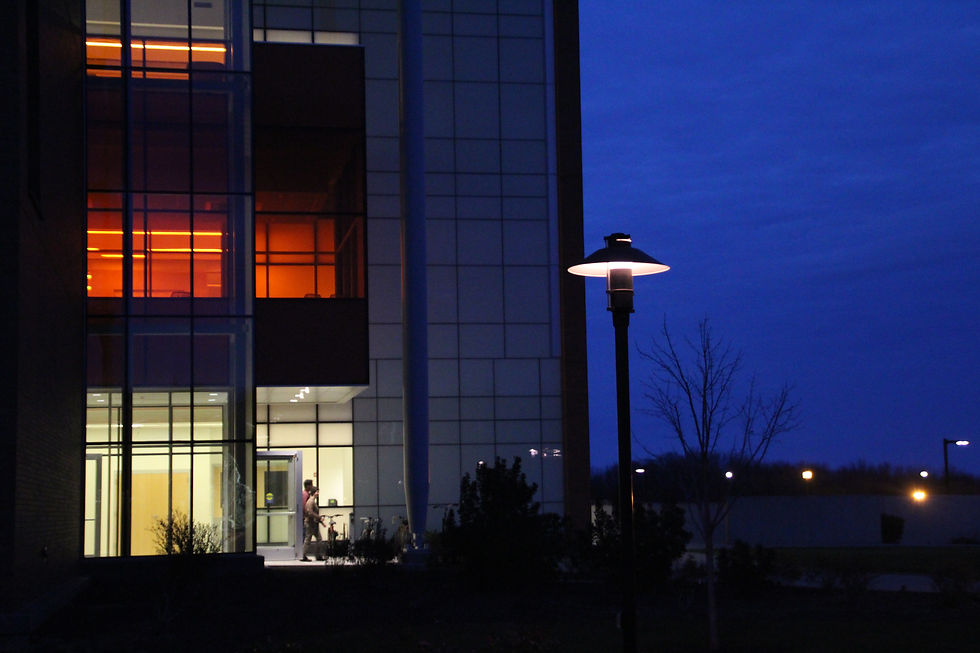
Exterior lighting will utilize wall mounted and pole top type luminaires. These will provide pathway and security illumination. The anticipated lamp source will be LED.

Different types of control system
Lighting controls of GIS building include:
-Zoning(Manual)
-Dimming(Manual/automatic)
-Occupancy sensors(Manual/automatic)
-Scheduling(Automatic)


Zoning
Zoning refers to the concept of creation of multiple zones that can be individually controlled to turn on/off or dim the lights within each zone.
Zoning is particularly useful in large spaces where only the occupied area is illumilated as per user requirement.

Figure 1 Illustration of zoning control
Dimming


Figure 2 Switch for dimming control in GIS Classrooms

Figure 3Energy saving potential using dimming control
Dimming control helps luminaires save energy even in an “on” state as compared to standard bulbs, which can only save electricity when switched off.
Figure 2 shows a 3-level dimming switch while Figure 3 denotes the energy saving for a 4-level dimming control switch.
On a moderately cloudy day, dimming to 50% reduces the equivalent energy usage from 10 bulbs to 5 bulbs in a classroom.
Occupancy sensor
The occupancy sensor located within each interior space is set up as a vacancy sensor requiring a manual "on" to turn the lights on within the space.
Scheduling controls
Scheduling controls are used in turning lighting systems off during unoccupied periods based on a fixed daily time schedule.
Interior spaces like galleria utilize this lighting control and contribute to energy saving.

Data from Webctrl database was used to analyze the electricity consumption of lighting during a weekday, and a weekend. From figure 4, it can be observed that electricity consumption of artificial lighting is almost zero during the day on a weekend, which clearly indicates that lighing consumption is sensitive to occupancy level in the building. On the other hand, on Tuesday, the load consumption of lightingis about 25kWh during the day. Also, the lighting load is almost similar during early morning, and after 8:00pm, as some amount of lights are switched on around the building irrespective of the occupancy level in the building for aesthetic, and security purposes.
Figure 4 Electrical consumption by lighting