SUSTAINABILITY
Golisano Institute of Sustainability
LIGHTING DESIGN

Orientation/Daylight
building passive design
Building Orientation and Daylight Usage

The orientation of GIS building is elongated across east-west direction, in order to maximize the daylight usage and reduce dependence on electric light sources. The southern side of the building comprises of offices and classrooms while the research labs and test-beds make up the north wing. Galleria serves as a connection between the north and south wings of the building.
Orientation of a building plays a vital role in
• Maximizing daylight usage
• Reducing lighting electricity load
Graphical representation of GIS building elongated along East-West direction


Passive Design
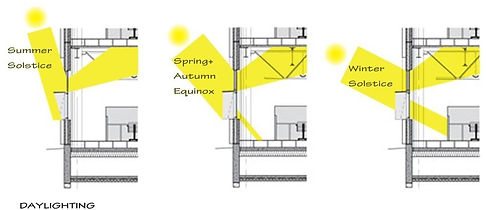
Figure 1
Source: Joann Gonchar, AIA 2010. Zeroing In on Net-Zero Energy. Published in Architectural Record

Passive Building Design
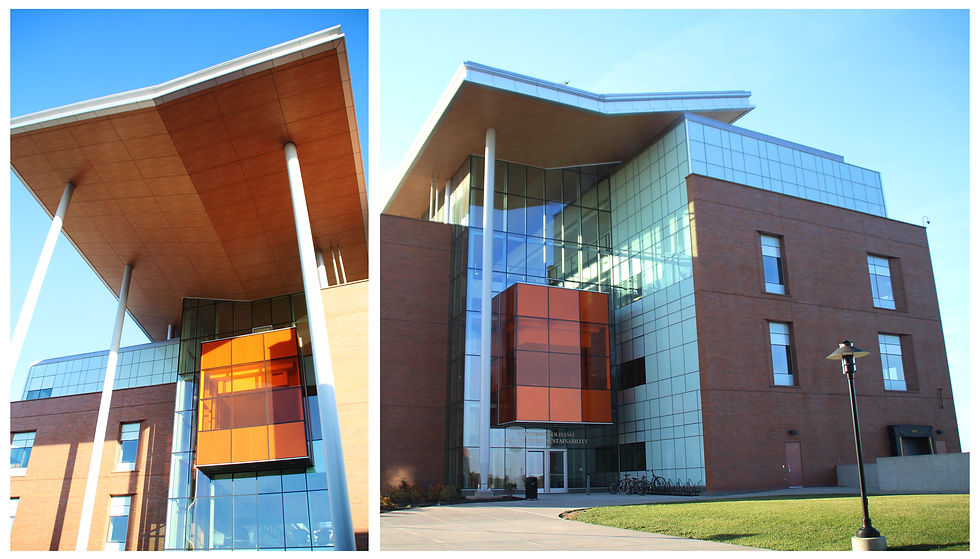
Wide array of windows on the south end are designed to increase the daylighting, reducing the need for artificial lighting, warming the building’s interior during the cold weather and providing a good view of the campus. Large horizontal metal louvers are fixed onto the windows, at an angle of 20 degrees, facing south, to offer protection against direct solar heat gain and glare, rain and violent wind. Owing to this feature, the building remains cool during summers, thereby reducing excess load on HVAC system.
Since the level of day lighting is less on the northern side as compared to south side of the building, a combination of clear and translucent glass windows are placed in this direction. The clear glass helps in bringing more daylight into the building and translucent glass helps to diffuse daylight inside the building. The translucent glass is filled with nanogel, which increases the diffusion of lighting and allows architects to apply more daylight in the building design.
Figure 2
Metal Louvers fixed near the windows at 20 degrees angle, in the Southern part of the building
Daylighting and Energy Usage
Webctrl database of GIS was used to analyze energy usage of artificial lighting over the period of one year in 2014. This trend in figure 3 clearly indicates that the electricity consumption during summer months from May-2014 to Aug-2014 was almost 70% less, as compared to the consumption levels during winter from Oct-2014 to Nov-2014. Further, it can also be observed that consumption during Jan-2014 is 36% less than during peak winter months, which clearly indicates that lighting in GIS is dependent both on weather patterns, and occupancy levels (due to winter break till Jan month end).
Overall, the lighting consumption tends to decrease from Jan. to Aug. and then increases from Aug.-Dec.
Experimentally, the level of daylighting was measured in both North and South directions of GIS building using Lux meters, to understand the natural lighting potential. The lux level of light was measured at 0%, 25%, 50%, 75%, and 100% away from the windows in classrooms (2nd and 3rd floor), and in decision theater. Figure 4, clearly indicates a decay of lighting level as we moved away from windows. Also, the lux level is high in southern part of the building as compared to northern side. Overall, on a moderately sunny day in Nov at about 12:00pm, it clearly indicates that the lux level of natural lighting in the room is more than sufficient to avoid artificial lighting. The average lux level in classrooms was 2000 Lux, which is amply sufficient as per LEED building code (LEED doc, SS credit 8. Also, decision theater in north has an average of about 500 Lux, which is a sufficient lighting level as per LEED building code (LEED doc, SS credit 8)

Figure 3
Electricity consumption of lighting from Jan-2014 to Dec-2014

Figure 4
Experimental measurement of daylight in GIS building on 15-Nov-2015